Technical
Projects, 1995-2017
(This section has been lifted from an earlier
webpage, and will be updated eventually.)
In
reverse order of creation, we have:
Solar-PV
Battery Charger
(Applied
to Unst Market Gardens' operation, May 2013)
The
U.R.G.E. (and later the Unst Market Garden) project depended
entirely for its survival on hill run-off water stored-up
during wet times. Accordingly, a large collection-pond was
dug out by the U.R.G.E. partners as a part of that project.
Inevitably, size limitations on this pond meant that a good
part of the collected water simply ran to waste in particularly
wet weather, and was all too quickly used up in dry times.
Also, the fact that the pond was at almost the lowest point
of the U.R.G.E. plot meant that all of the water collected
in it either had to be taken to the (many) points of use by
hand, or pumped there by some means. This problem remained
unsolved for U.R.G.E., although the idea of hammer-pump equipment
was considered seriously at one point. Later, when U.R.G.E.
came to an end and the Unst Market Garden project was initiated,
a drainage channel was dug to provide water from this pond
to the new site. UMG is several metres lower than the pond
itself, which seemed to offer a possible free advantage.
In spite of the
height difference between the collection-pond and the storage
tanks at UMG, it quickly became clear that relying on gravity
alone to do the work wasn't going to be a solution. The main
reason for this was that a syphon couldn't be established
and maintained without installing some fairly fancy plumbing.
A number of ideas were considered for pumping this water into
storage containers on the Unst Market Garden site. Nearly
all of them were discarded as being too expensive and/or too
unwieldy and impractical to implement. My initial suggestion
on this problem was that 12V submersible pond pumps and car
batteries would probably be the cheapest, easiest, most reliable
and least high-tech way to provide such a facility. Sarah
implemented this idea more or less straightaway, and as a
result now has the means to buffer-store about eight tonnes
of water. At the same time, she installed pipework into the
main tunnel so that water is now on-tap at all times.
Needless to say,
the car batteries that provide the power to run this setup
regularly (and all too often) had to be lugged back and forth
over several hundred metres of very rough ground to Sarah's
house for recharging. The long-term orthopaedic risks of this
kind of operation were all too clear to me, as someone who'd
used up all of his luck in that direction a long time ago;
so I decided to try to find a way to re-charge those batteries
on-site. A quick hunt around on Amazon and then eBay turned
up the required item: all that remained to be done then was
to install it in a suitable location - on the side of a south-facing
shed in the middle of the UMG site, as it turned out - because
that spot receives direct insolation during the whole day,
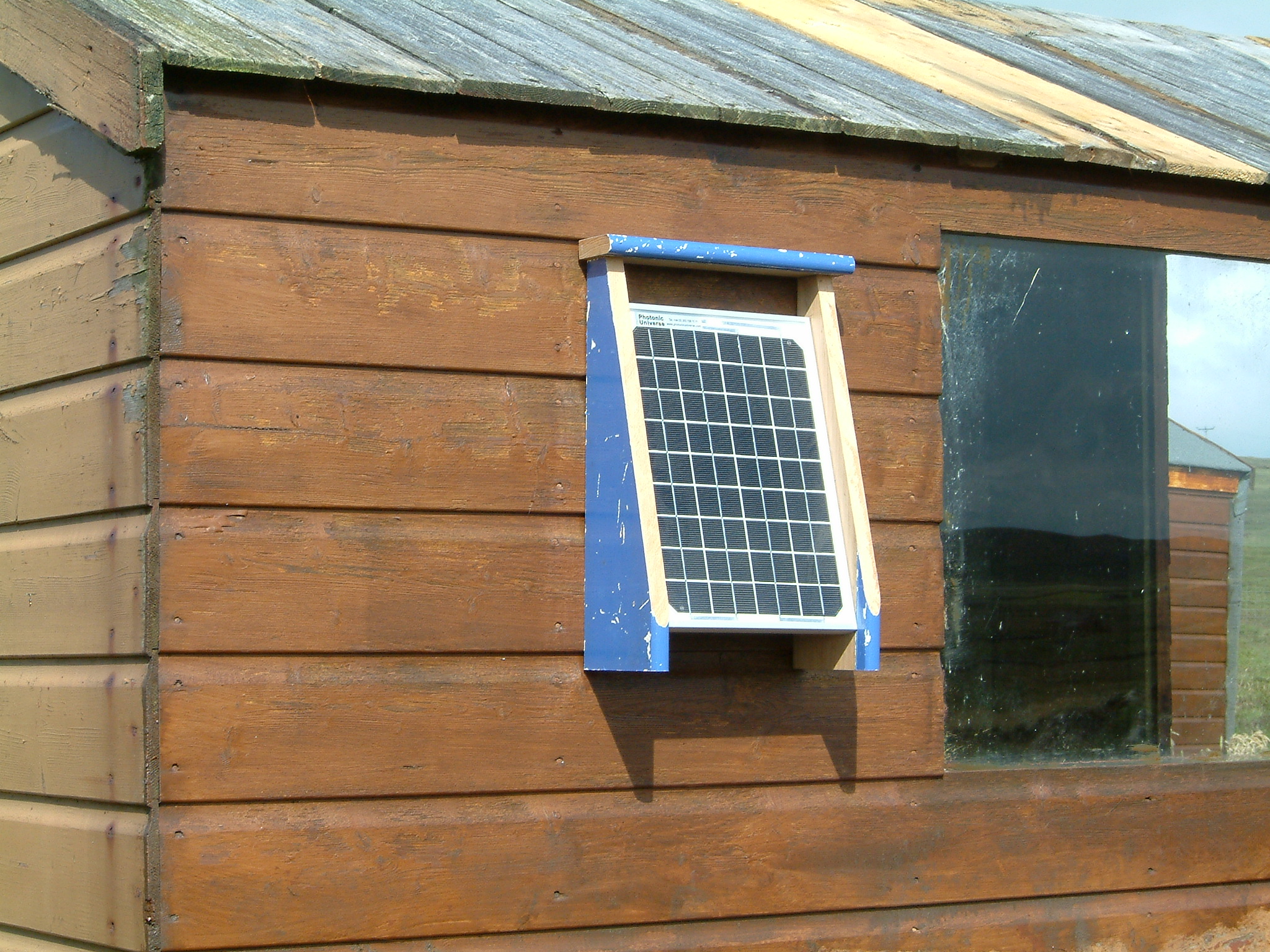
all year round. The finished installation looks like this:
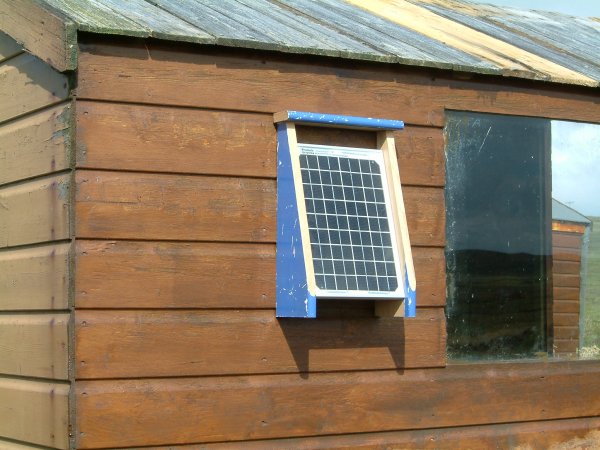
The
panel's supporting frame was made from a nice little chunk
of recycled window-sill wood, salvaged from a recent SIC property-upgrade
exercise carried out on Unst. The angle of tilt ensures that
the panel is more-or-less flat-on to available incident sunlight
during the six months on Shetland when insolation is at a
lower level.
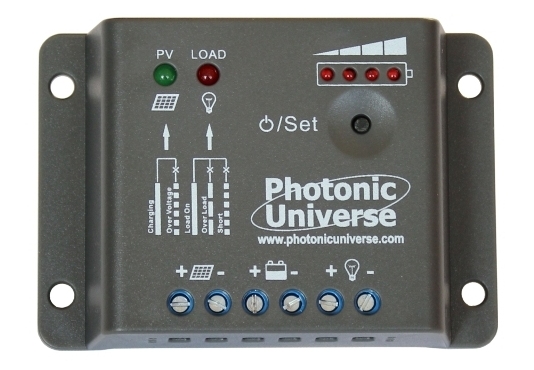
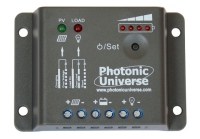
The processor-based
smart control panel is fitted inside the shed out of the weather,
and looks like this:
The
whole thing was simplicity itself to install and set up; and
at the time of writing (May 2015) appears to be doing its
job properly and unobtrusively. In my honest opinion, it was
(and continues to be) a jolly good £50-worth. You may
be able to view it online by clicking here.
|
| The
Unst Regeneration Growers' Enterprise, 2010
(Webpage
re-design / rebuild - 2010)
 |
| The
'GDA -Belmont' Solar & Wind-Powered Domestic Heating System
(also known as 'The Thing')
(A self-designed
and self-built technical project, 2009-14)
Shetland
is enjoyably chilly almost all the year round. That's
fine
(if you like that sort of thing) as
long as it's possible to keep moving, and to dress accordingly.
Personally I find it to be healthy, invigorating and quite
comfortable - but it's not so good when it comes to trying
to maintain a sensibly-warm environment inside a house;
and especially not in winter.
The three main
types of heating system in use in Shetland's houses are:
- open
wood, coal and peat fires (handy for those with their
own peat banks to harvest);
- electric
storage radiators (which are difficult to control and
very costly indeed to run); and
-
oil-fired systems.
All
three of these heating systems have huge drawbacks, the
main one in all cases being cost of operation. (Peat may
well be free to harvest: but collecting it requires a
lot of personal effort and a vehicle of some sort, and
peat smoke can be a considerable problem for neighbours.)
Two of them at least also suffer from the crippling disadvantage
of being dependent on a reliable supply of mains electricity
in order to be able to carry on operating. On Shetland,
with its unexpected (and very often extended) weather-related
power outages (which don't always occur in winter), this
can be a major problem - especially for older people who
rely on being able to keep themselves warm without taking
exercise. Another part of the problem is that Shetland
housing requires heating nearly all the year round - even
in 'summer', which can easily be foggy, cold, windy, wet
and generally November-like.
So - the design
specifications that I decided to work to while trying
to create my own 'alternative' heating system became:
Note that the original details of this particular project have now been removed from this page.
You can thank the utterly treacherous, incomer-hating, incomer-scornful and generally lazy incompetence on the part of SIC's Housing Department for this bit of 'editing'; due to its pandering to (and complicity-in-support of) the malicious spitefulness of the envious, lying, thieving, police-manipulating, unseemly and un-neighbourly, petty-criminal Scottish tenement-trash tenants, who are the current occupants of the address known as 'Ferryman's House 1, Belmont, Uyeasound, Unst, Shetland Islands'.
Some of the immediate locals are also in the frame in this matter - but their sly and cowardly contributions to the overall situation are about to be catalogued and pilloried elsewhere on this website, to Shetland's extreme detriment. They will NOT love it.
In summary: the current occupants of 1, Belmont's four years of cowardly, disruptive and spiteful antics have just cost Shetland the whole of my goodwill.
What what should have been the free gift (from me, to all of its people) of an easy, comfortable, cheap-energy existence
for the whole of the rest of its future is now lost: but that's not my problem anymore; it's Shetland's.
|
|
 |
|
To
create a supporting web-page for Sarah McBurnie's
'See
Shetland Tours'
mini-bus Shetland sight-seeing tour operation.
(Ongoing project)
|
 |
|
Webpage:
Self
PDF
Leaflets:
Sarah McBurnie / Self
Text
& Photos:
Sarah
McBurnie/Self |
 |
Realisation
/ layout: |
Self,
after discussion. |
| |
|
To
correct, improve and extend an existing web-page, to advertise
more effectively a range of Financial Services.
(Ongoing project)
|
| |
By
A.N. Other, at BT Connect. |
| |
Self, after discussion with the client.
|
| P.C.TOYs
(Web-page
creation)
|
PROJECT
REQUIREMENT:
|
To
create a simple, compact web-page, to advertise the Pierre Cardin
Enfants range of soft toys. |
| Basic
design: |
Leonhard Augenstein,
Self |
| Realisation
/ layout: |
Self |
| Impreline
Technologies Ltd:
(Creation
of two technical manuals)

Impreline's
UK in-place pipeline-rehabilitation manual, which details the
method of installation of epoxy-impregnated felt liner material
into damaged sewers to effect leak-repair. UK and US versions
were created as parts of the same project.
The
manuals' contents are proprietary technical information, and
the material has therefore been withheld from general display.
--- |
PROJECT
REQUIREMENT: |
To
create a CD-distributable PDF-format version of the existing
(185-page Word 97-format) Impreline Technologies Lateral Lining
Manual.
To
include a full range of scanned diagrams (supplied in printed
form), and some colour photos;
To incorporate an existing colour advertising-brochure into
the Manual;
To
try to achieve a >45:1 reduction in production and distribution
costs, over the original (paper) manual (>48:1 estimated).
|
Basic
text / images/ layout:
|
Impreline
Technologies Ltd, Self |
| Realisation,
Proof-Reading, Text Corrections and final layout: |
Self |
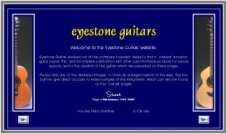
| Eyestone
Guitars:
(Web-page creation)
|
PROJECT
REQUIREMENT:
|
To
create a simple, compact web-page, advertising the Eyestone range
of acoustic guitars; this was version 11 (eleven) of the page.
The page is undergoing a rewrite at the moment.
|
| Basic
design/layout: |
Leonhard Augenstein,
Self |
| Realisation
/ guitar video-samples: |
Self |
| Half-speed
Video on CD:
(Create a personal guitar-tuition
resource)

Click this image to see the full-speed RealPlayer clip at 8
fps.
___
Click
this image to see the same clip at half-speed, again at 8 fps.
___
These are compact samples - the 'real things' are in MPG format,
and run at 25 fps, 320 x 240 pixels frame-size.
|
PROJECT
REQUIREMENTS: |
To
sample and encode video-footage of guitar-players, for puropses
of transcribing their music for hobby and personal (non-commercial)
use.
To
render the results into true half-speed format, where no pitch
shift occurs in the music.
To maintain absolute synchronisation between sound and vision
on all samples.
To
make the samples emulate display on a small (portable) colour-TV,
on any Windows 9X PC equipped with a P200 MMX (or faster) CPU.
|
| Research
& Design: |
Self |
| Realisation: |
Self |
| Augenstein
Design GmbH
(Image-Scanning Project)
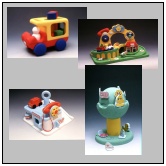
The
images form an 'ideas catalogue-on-CD' of approximately nine
years of Augenstein Design GmbH's design activities, in the
field of children's toys and other leisure-type equipment. |
PROJECT
REQUIREMENTS:
|
To
scan and convert 2,300 photographic slides of toy and leisure-equipment
designs to JPG-format images on CD-R disk;
To
create a clickable-link Access database of the results;
To organise (and assign unique DOS-compatible names to) the original
slides.
|
| Materials/scanner: |
Supplied
by Leonhard Augenstein.
|
| Realisation/method:
|
Self |
| Augenstein
Design GmbH
(Web-page
alterations)

|
PROJECT
REQUIREMENT: |
To
apply slight modifications to text/English translations, within
an existing web-page, by suggestion and discussion.
Later modifications included a complete revision of the structure
and contents.
The project is ongoing (as at March 2002). |
|
The late Robert Bryan Andrews, F.R.C.O.
- Two concert recordings -
(Two live recordings, 1992 and 1995)
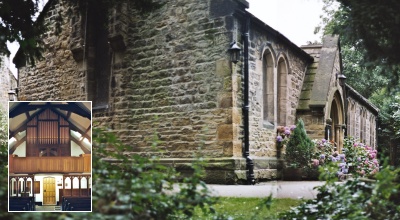 - Esholt Church,
Esholt Village, West Yorkshire -
- Esholt Church,
Esholt Village, West Yorkshire -
|
-
The Esholt Church Recital Practice Session, April 1992
-
|
|
01
- ?
02
- ?
03
- ?
04
- ?
05
- ?
06
- ?
07
- ?
08
- ?
09
- ?
10
- ?
|
I'd
be very pleased to hear from anyone who could put
titles to the musical offerings listed above.
Please contact me here
about it.
|
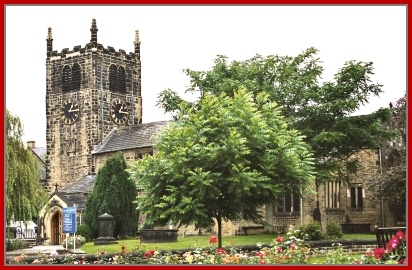 -
Bingley Parish Church, Bingley, West Yorkshire -
-
Bingley Parish Church, Bingley, West Yorkshire -
|
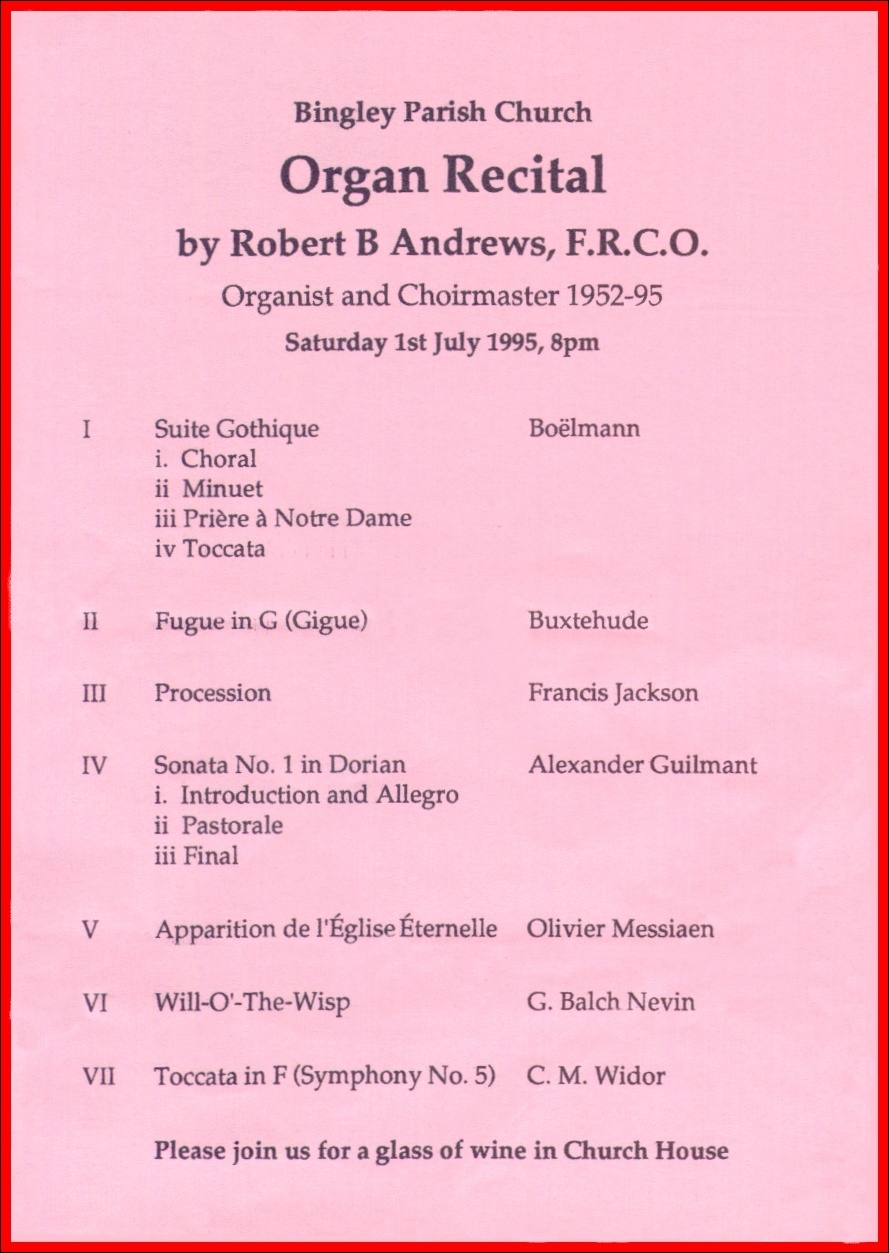
- The Organ Recital at Bingley Parish Church, Saturday 1st
July 1995 -
|
|